Organic Fertilizer and Briquette Plant Construction Begins in Yilo Krobo
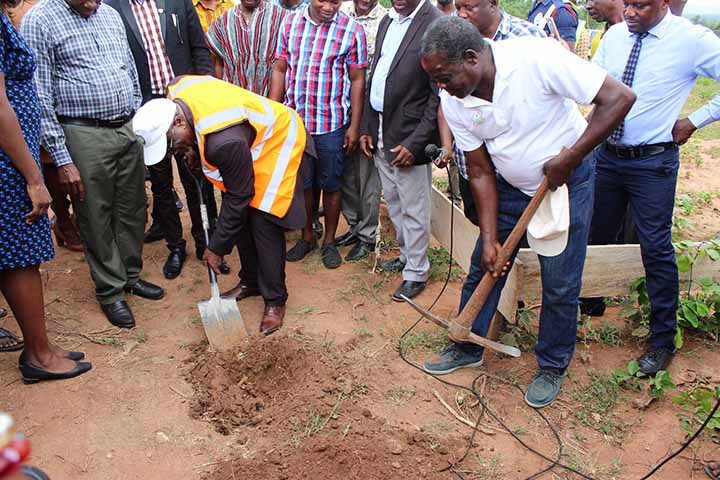
The construction of a fertilizer production factory under the one district one factory initiative has commenced in Somanya in the Yilo Krobo Municipality, to process both faecal and bio-degradable waste.
The construction of the factory is part of the "Creating and Capturing Value" (CapVal) project launched in 2015 by the International Water Management Institute (IWMI) and Jekora Ventures Limited with support from the Netherlands Enterprise Agency. The CapVal project seeks to demonstrate that sanitation and waste management could support a circular economy.
Project Goals and Capacity
At a ceremony to launch the construction of the fertilizer production factory, Dr Josiane Nikiema, the Representative from IWMI, said the Institute was focused on the sustainable use of water and land resources in developing countries. She said for more than a decade, IWMI had been exploring ways to recover useful materials from waste generated in urban settings such as wastewater, faecal sludge and agro-industrial waste among others.
Dr Nikiema said the smaller facility would be positioned to produce 200 metric tonnes of compost annually by transforming 5,000 cubic metres of faecal sludge and 300 metric tonnes of solid waste. She said there would also be a bigger processor within the factory, which would produce 1,000 tonnes of low-cost fuel briquettes annually for use by households and institutions in the Municipality.
Regional Minister's Remarks
On his part, Mr Eric Kwakye Darfour, the Eastern Regional Minister, said the siting of the plant would help in making good use of waste generated in the community and its environs such as maize husk. He added that it was commendable as waste products over the years had posed many environmental problems.
He said there was no doubt that agriculture was the major economic activity in the Yilo Krobo Municipality, adding that the farmers relied heavily on fertilizers to cultivate crops due to the land tenure system. Mr Darfour said the coming of the fertilizer factory into the Municipality would help farmers to readily get access to fertilizers to grow their crops for successful outcomes each season.
He commended the Netherlands Enterprise Agency and other partners who are supporting financially to bring this project to fruition.
Netherlands Partnership
Ms Katja Lasseur, the Deputy Ambassador of the Netherlands to Ghana, said the Netherlands Government had committed itself to dealing with available resources in a smarter way. She said: "We are trying to consume less and maximise the reuse of raw materials with the aim of having a circular economy in 2050."
Ms Lasseur said the country was committed to working with other nations to achieve its aim and in the process learn from partner countries like Ghana and that the CapVal Project was a perfect example of such partnership.
Local Content and Employment
Mr I. B. Nartey-Tokoli, the Managing Director of Jekora Ventures Limited, said the construction of the factory would pave the way for its inauguration early next year. He said the contractor was selected from the Municipality and that all the artisans working on the project are from the community as part of ensuring that there was strong local content in the entire process.
Mr Nartey-Tokoli said Jekora Ventures anticipated the construction of the factory and subsequent operation of the facility would be a local solution, using low-cost appropriate technology.
Municipal Assembly's Perspective
Mr Ebenezer Tetteh Kupualor, the Municipal Chief Executive of the Yilo Krobo Municipal Assembly, said one of the highest expenditures from the Assembly's fund was waste management, which takes about 23 per cent. He said equipment, labour and land were three critical resources needed for sustainable waste management but the availability of land had become a very difficult challenge to the Assembly.
He said waste management had become one of the main challenges for most local authorities and that the Municipality was no exception, adding that the commencement of the factory in the Municipality would empower them in the effective management of waste.
By Julius K. Satsi, GNA